PODCASTS
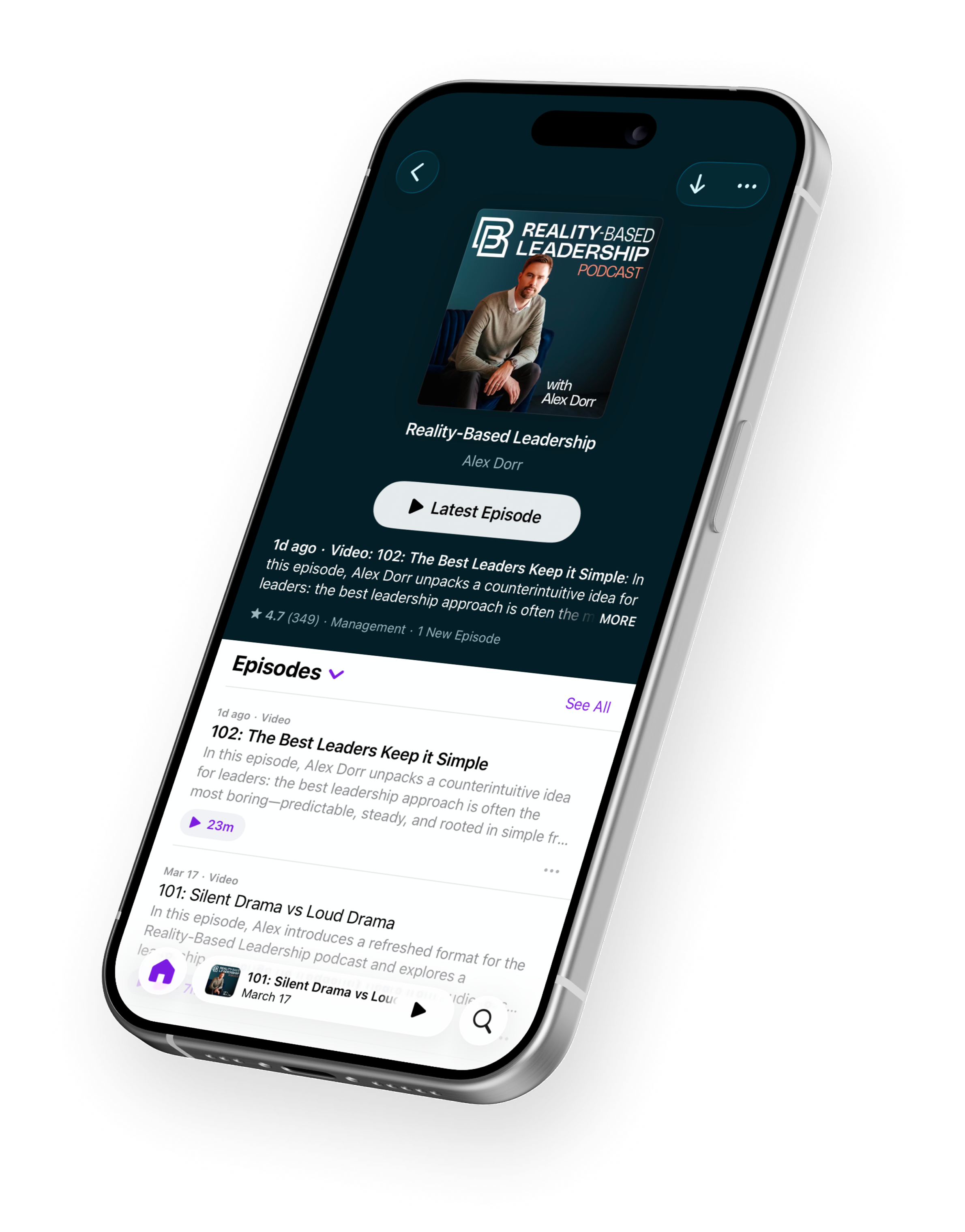
Reality-Based Leadership
The Podcast
A top 1% podcast globally - where thousands of leaders each week learn to ditch the drama, build aligned teams, and call those they lead to greatness.



Leaders today are being called to do more than ever - increasing complexity, constant change, and growing uncertainty. Many are noticing that the conventional leadership wisdoms we've been taught are no longer effective in today's evolving workplace.
These times call for a modern way to lead - one that works within reality, instead of arguing with it.
This podcast features Alex Dorr, CEO of Reality-Based Leadership sharing his latest insights from his speaking engagements across the world. Sometimes it may be audience questions that sparked great discussion, new ideas or techniques to address sources of drama or even, off the cuff topics from the amazing conversations after keynotes.
Work can be effortless and teams can be drama-free. Each 15-20 minute episode will show you how to make it happen.
Episodes



123: How We Could Book Series Part 3: Leadership Tools to Coach Your Team to Accountability
Get your copy of How We Could for you and your teams today at:
Amazon - https://www.amazon.com/How-Could-Framework-Alignment-Greatness/dp/B0GRWV76P5
Barnes & Noble - https://www.barnesandnoble.com/w/how-we-could-alex-dorr/1149680412?ean=9798886455168&utm_source=website&utm_medium=book_page&utm_campaign=how_we_could&utm_content=barnesandnoble
Bookshop.org - https://bookshop.org/p/books/how-we-could-the-framework-to-lead-without-drama-build-alignment-and-call-teams-to-greatness-alex-dorr/d73c23906d4a61a0?ean=9798886455168&next=t?utm_source=website&utm_medium=book_page&utm_campaign=how_we_could&utm_content=bookshop
Books-A-Million - https://www.booksamillion.com/p/How-We-Could/Alex-Dorr/9798886455168?utm_content=bookshop
Here is a link to the tools mentioned in this podcast:
SBAR tool - https://info.realitybasedleadership.com/tool
Thinking Inside-the-Box tool - https://info.realitybasedleadership.com/box
Negative Brainstorming tool - https://youtu.be/AV6n69QCVnY?si=q7r_pglJsatIb-l2
Or grab all of the Toolkit tutorial videos, PDF and the new Call to Greatness Toolkit that accompanies the book here:
https://info.realitybasedleadership.com/greatness
In Part 3 of his How We Could Book Club Podcast Series, Alex Dorr shares his favorite quotes, insights, and lessons from the final section of his new book. In this episode, you'll learn three tools that help your team move forward productively even when facing resistance to change and uncertainty. It's a motivating listen for anyone looking to lead their team differently through ambiguity.
Episode Highlights:
00:01:25 - How the book took three years and is packed with real case studies
00:02:10 - Recap: the three parts of How We Could (loving up, calling up, answering the call)
00:04:26 - Introducing Part 3: answering the call to greatness
00:04:51 - Why fear is what really holds people back from taking action
00:07:07 - The three tools for next right action: SBAR, thinking inside the box, negative brainstorming
00:10:34 - When to use each tool
00:13:39 - Deep dive: how the SBAR cuts down workplace drama
00:19:30 - Deep dive: why "thinking inside the box" drives real innovation
00:22:39 - Deep dive: negative brainstorming and the Dr. Smith story
00:27:06 - Wrapping up Part 3 and celebrating the book launch
123: How We Could Book Series Part 3: Leadership Tools to Coach Your Team to Accountability
Get your copy of How We Could for you and your teams today at:
Amazon - https://www.amazon.com/How-Could-Framework-Alignment-Greatness/dp/B0GRWV76P5
Barnes & Noble - https://www.barnesandnoble.com/w/how-we-could-alex-dorr/1149680412?ean=9798886455168&utm_source=website&utm_medium=book_page&utm_campaign=how_we_could&utm_content=barnesandnoble
Bookshop.org - https://bookshop.org/p/books/how-we-could-the-framework-to-lead-without-drama-build-alignment-and-call-teams-to-greatness-alex-dorr/d73c23906d4a61a0?ean=9798886455168&next=t?utm_source=website&utm_medium=book_page&utm_campaign=how_we_could&utm_content=bookshop
Books-A-Million - https://www.booksamillion.com/p/How-We-Could/Alex-Dorr/9798886455168?utm_content=bookshop
Here is a link to the tools mentioned in this podcast:
SBAR tool - https://info.realitybasedleadership.com/tool
Thinking Inside-the-Box tool - https://info.realitybasedleadership.com/box
Negative Brainstorming tool - https://youtu.be/AV6n69QCVnY?si=q7r_pglJsatIb-l2
Or grab all of the Toolkit tutorial videos, PDF and the new Call to Greatness Toolkit that accompanies the book here:
https://info.realitybasedleadership.com/greatness
In Part 3 of his How We Could Book Club Podcast Series, Alex Dorr shares his favorite quotes, insights, and lessons from the final section of his new book. In this episode, you'll learn three tools that help your team move forward productively even when facing resistance to change and uncertainty. It's a motivating listen for anyone looking to lead their team differently through ambiguity.
Episode Highlights:
00:01:25 - How the book took three years and is packed with real case studies
00:02:10 - Recap: the three parts of How We Could (loving up, calling up, answering the call)
00:04:26 - Introducing Part 3: answering the call to greatness
00:04:51 - Why fear is what really holds people back from taking action
00:07:07 - The three tools for next right action: SBAR, thinking inside the box, negative brainstorming
00:10:34 - When to use each tool
00:13:39 - Deep dive: how the SBAR cuts down workplace drama
00:19:30 - Deep dive: why "thinking inside the box" drives real innovation
00:22:39 - Deep dive: negative brainstorming and the Dr. Smith story
00:27:06 - Wrapping up Part 3 and celebrating the book launch
122: How We Could Book Series Part 2 - Calling People Up to Clarify the Problem, Take Accountability and Build Alignment on Your Team
In this episode, Alex Dorr breaks down his favorite quotes and insights from Part 2 of How We Could. You'll learn practical ways to clean up your thinking, build real accountability across your team, and make sure people are in the right role for what the situation actually requires. This is part two of a three-part series digging into the sections of the book that didn't make the final cut, sharing Alex's exclusive insights to enrich your reading experience.
Pre-order How We Could for you and your team (official release date is September 22nd): https://www.realitybasedleadership.com/pre-order
Episode Highlights:
00:00:18 – Welcome and episode intro
00:01:42 – Recap of Part 1 and transition into Part 2
00:04:04 – Part 2 begins: calling people up to greatness
00:04:22 – Step two overview: cleaning up thinking
00:09:34 – Why the five-step sequence matters (the "secret sauce")
00:14:17 – Diving into clean thinking: ego, stories, and facts
00:20:24 – Step three: accounting for our part in the mess
00:24:41 – Breaking down accountability: account + ability
00:27:30 – Step four: knowing your role in the solution
00:34:05 – Non-negotiables, procedures, and avoiding burnout
121: How We Could Book Series Part 1: Love People Up - Sharing Favorite Insights and Quotes from My New Book
In this episode, Alex discusses his favorite quotes and insights from his new book, How We Could. He goes deeper into everything that influenced what he wrote about in Part 1 and why he thinks it's important for your leadership and your team. This is Part One of a 3-Part Book Series discussing the biggest breakthrough insights from each part of the new book, from Alex's perspective.
Pre-order How We Could for you and your team (official release date is September 22nd): https://www.realitybasedleadership.com/pre-order
Episode Highlights:
00:00:20 Welcome back and two weeks from the launch of How We Could
00:01:29 Why Alex decided to do a three-part series through the book
00:03:03 Certification event announcement for November 12th and 13th in Dallas
00:03:11 A leader's story of using the framework during a sudden team transition
00:09:01 Introducing Part One, Loving People Up, and the structure of the book
00:11:23 The difference between empathy and sympathy
00:16:37 The keys to validating someone's experience and being a soft place to land
00:20:17 How rushing to fix a problem robs someone of the chance to evolve
00:26:36 Every frustration holds a call to greatness
00:30:29 Wrap up and closing thoughts on Part One
About Reality-Based Leadership keynotes, trainings and workshops: Based on 25 years of delivering research and delivery of leadership development programs in top companies in the world, Reality-Based Leadership helps leaders and teams ditch the drama, restore sanity to the workplace and turn excuses into results. RBL's keynotes, workshops, leadership development programs, virtual courses, assessments and tools equip leaders to recapture the 2.5 hours per day the average person is spending in drama and put that energy back towards achieving goals and high employee engagement.
120: Two Concerning Ways AI Is Increasing Drama on Teams
This episode explores two emerging ways AI is starting to double the amount of drama happening on teams. The challenge is that those who may be lower in accountability can add more drama to your culture through careless AI use, sending along unprocessed "AI slop" that shifts the burden of thinking and cleanup onto whoever receives it. Meanwhile, your high accountables may be exponentially increasing that same drama by turning judgmental toward colleagues who are still finding their footing with the tool, sometimes writing off genuinely strong work simply because it looks AI-generated. This episode names the emerging problem on both sides and discusses practical ways to bridge that gap, refocus on self-reflection and personal accountability, and bring teams back together instead of splitting into judgment and defensiveness.
Episode Highlights:
00:01:41 – Alex introduces the two ways AI use is increasing drama on teams
00:03:26 – The defining characteristics of AI slop: illusion of progress, shifted burden, receiver disengagement
00:05:01 – How a high accountable mindset processes receiving AI-generated work
00:07:18 – The break in trust that happens when unprocessed AI work lands on someone's desk
00:08:00 – Why self-reflection tools work through visual processing instead of verbal venting
00:11:12 – How AI accelerates the pattern of intellectualizing instead of truly reflecting
00:12:56 – Alex's idea for building self-reflection prompts into AI tools themselves
00:14:07 – The second source of drama: high performers judging others' AI use
00:16:03 – Applying "stop judging, start helping" to AI-era team dynamics
00:18:03 – A real example of a colleague wrongly assuming a photo was AI-generated
00:19:49 – Alex previews his upcoming book, Checkmate to Drama
Link to pre-order Alex's book, How We Could: The Framework to Lead Without Drama, Build Alignment and Call Teams to Greatness for you and your teams:
https://www.realitybasedleadership.com/pre-order
119: Why Good Leadership Advice Drifts to Bad Leadership Behavior
In this episode, I explore a fascinating idea about near and far enemies and how it links to leadership and the tendency for even the best leadership tips, tools and advice to accidentally get used in the wrong way. This episode dives deep into the deeper parts of ditching the drama that leaders may feel they are coaching well on moving people past the key sources of drama - lack of accountability, ego-based behaviors such as venting, resisting change and lack of alignment to decisions - but missing massive opportunities because they are labeling too soon behaviors from their team as simply "sources of drama". Understanding the near enemy or the patterns that look like drama, but may actually be real nuanced concerns coming from your team will allow you to take your leadership to the next level and continue to modernize how you lead.
Episode Highlights:
00:01:16 – Setting up the topic: why good leadership advice can accidentally create bad leadership
00:01:33 – Introducing the Buddhist concept of "near and far enemies"
00:02:41 – Client call story: bringing up "structure" with a fast-scaling, innovation-driven team
00:04:22 – Near enemy example #1: empathy vs. sympathy
00:05:42 – Near enemy example #2: discipline vs. rigidity
00:06:56 – The Olympic athlete "no noise after 8pm" story
00:08:06 – Back to the client: renaming "structure" to get buy-in
00:08:58 – Connecting the pattern to Reality Based Leadership's four sources of drama
00:10:04 – Near enemy example #3: shutting down venting vs. shutting down real concerns
00:11:47 – Near enemy example #4: wholehearted buy-in vs. conditional buy-in
00:13:04 – Near enemy example #5: drama-free culture vs. drama-avoidant culture
00:14:16 – Near enemy example #6: accountability vs. overfunctioning/burnout
00:15:32 – How We Could book plug and Mel Robbins endorsement
00:17:30 – Real session story: a team member's "conditional buy-in" moment and the negative brainstorming tool
00:22:58 – Closing reflection: spotting your own near enemies over the next two weeks
118: Healthy and Unhealthy Debate in Your Company - How to Know the Difference
When smart teams can wrestle with ideas and build on each other's input to get to the best ultimate solution, it is where companies thrive. When it is done well it is truly a thing of beauty, and this type of ability is what unlocks the most innovative companies in the world. When this turns unhealthy or people begin to debate in a drama-filled way, it can lead to some of the biggest detrimental effects to company culture. In this episode, Alex shares exactly what healthy debate looks, feels, and sounds like from a Reality-Based low drama perspective, and gives you a few practical tools and techniques you can bring in if some of your discussions tend to get heated and cross a line.
Here is the link to the Negative Brainstorming tool that Alex mentioned: https://www.youtube.com/watch?v=AV6n69QCVnY&list=PLZWrCbJ7Bukuwek8D2y-6QAyGFAiuiB9a&index=2
Here is a link to learn how to share input in the form of expertise (and not opinions), which Alex mentioned in the video. This is a skilled and respectful way to debate ideas and move forward productively when adding your perspective: https://www.youtube.com/watch?v=wLBUIVTzVIE&list=PLZWrCbJ7Bukuwek8D2y-6QAyGFAiuiB9a&index=4
Episode Highlights
00:03:09 Are you debating the what or the how?
00:05:01 Are you playing the wrong role in the conversation?
00:08:01 Is your team still fighting a decision that's already been made?
00:08:59 What is the negative brainstorming tool, and why does it work?
00:12:53 How do you turn post-decision frustration into forward motion?
00:15:04 What happened when one company ran a "break it" session before a major rollout?
00:19:18 Can shared language defuse tension before a hard conversation even starts?
00:23:01 Are you disagreeing with the idea, or attacking the person?
00:25:03 Why won't facts change someone's mind if facts didn't get them there?
00:27:39 What's your biggest tell that debate has turned unhealthy?
117: Why Learned Helplessness Holds Teams Back and Is the Opposite of Accountability
What happens when your team stops trying - not because they can't, but because they've decided it won't matter anyway? Alex Dorr, CEO and host of the Reality-Based Leadership Podcast, unpacks the psychological phenomenon behind stalled accountability: learned helplessness. It's the belief that your actions no longer shape your outcomes. It's contagious. And it's often hiding in plain sight, disguised as "that's just how things are here."
Alex walks through two classic experiments to show how deeply this pattern gets wired in, then turns the mirror on himself with a personal story about a phantom leg cramp that limited him for six years. From there, he offers three practical techniques leaders can use immediately: naming excuses and asking "what else could we try," swapping victim-questions for ownership-questions, and reframing impossible goals into small, doable next steps.
Learned helplessness isn't a character flaw. It's a habit. And habits can be broken. Listen in, then go work on it with your team this week.
Episode Highlights
00:02:27 What learned helplessness actually is
00:04:02 The flea experiment
00:06:38 The five monkeys experiment
00:08:27 Phrases that signal learned helplessness
00:10:03 Alex's personal story: the lunges that haunted him
00:14:04 Technique 1: name the excuse, ask what else
00:15:08 Technique 2: swap why and who for what and how
00:17:41 Technique 3: thinking inside-the-box
116: The Backstory of My New Book, How We Could, Releasing in September
We are officially 2.5 months out from the launch of my new leadership book How We Could. This book will transform how leaders handle drama in the workplace and ensure that all of your teams can move anyone from why they can't to how they could regardless of circumstances.
This simple 5-step framework helps leaders to perfectly balance being their for their teams with empathy and authenticity while still calling them up to deliver on the important results your organization has been asked to deliver. In this episode, I share exactly who the book is for, what the 5-step framework is all about, why this book takes all 30 years of Reality-Based Leadership's research to a new level and how it fills in the gaps that our organization and content hadn't filled until now.
Buckle up and get your pre-order fingers ready - this book will transform your team to have the best year they've ever had in 2026 and beyond!
Link to pre-order How We Could: The Framework to Lead Without Drama, Build Alignment and Call Teams to Greatness for you and your teams:
https://www.realitybasedleadership.com/pre-order
To order 10+ copies for your team please reach out to info@realitybasedleadership.com
Link to join our newsletter for free exclusive videos, leadership tips, content and events:
https://www.realitybasedleadership.com/#newsletter
Episode Highlights:
00:01:36 – Why this book, "How We Could," matters now
00:03:06 – Pre-order bonuses and bulk orders for teams
00:06:38 – The backstory: where the framework came from
00:11:27 – The Call to Greatness framework is born
00:14:01 – Why empathy without accountability becomes sympathy
00:17:26 – The five steps explained (love up, clean thinking, find your part, know your role, take action)
00:25:28 – When and where to use the framework
00:29:25 – The SBAR tool and why tools alone aren't enough
00:35:37 – Touch-and-go moments vs. calls to greatness that take years
00:44:01 – Closing thoughts and pre-order details
115: What Would Great Look Like? One Question to Stop Drama in 10 Seconds or Less
Are you or your team stuck in frustration when things go wrong — blaming circumstances, venting, or spiraling instead of moving forward?
In this episode of the Reality-Based Leadership Podcast, Alex Dorr shares the single most powerful coaching question every leader should have in their back pocket: What would great look like? It sounds simple. But used at the right moment, it can shift someone from full-blown drama mode to clear, accountable action in seconds.
Alex takes you behind the scenes of a real event-day crisis — a billing error, a leader on the verge of a meltdown, and a colleague who chose to coach instead of fix, and breaks down exactly why this question works, when to use it, and how to make it land.
If you're a leader, manager, or team member who wants to stop spinning in frustration and start adding value in messy moments, this episode gives you exactly what you need. Because the goal isn't a perfect reality. It's knowing what great looks like, and choosing to go be it.
Episode Highlights:
00:01:12 - The one coaching question every leader needs
00:01:27 - The three ways to ask it
00:02:04 - The certification event story begins
00:03:20 - The billing error crisis
00:04:15 - Spiraling into low self
00:05:31 - The colleague who coached instead of fixed
00:06:25 - Why relationship matters before using this question
00:06:44 - The question lands — and shifts everything
00:08:17 - "Sounds like you already know what great looks like"
00:09:15 - Why typical "got a minute?" meetings cost you more
00:10:13 - Accountability after the moment passes
00:11:40 - Why this is the most powerful coaching question
00:12:09 - Low self vs. high self explained
00:14:08 - How the question moves us from ego to self-reflection
00:15:49 - Using it on yourself when you want to disengage
00:16:16 - Why fixers and over-functioners need this question most
00:18:49 - We all already know what great looks like
00:19:33 - Your assignment and takeaways
114: How to Stop Arguing With Reality and Keep Teams From Endless Frustration
Are you or your team stuck in frustration over things you can’t control? Do small disruptions turn into outsized stress, blame, or wasted energy?
In this episode of the Reality-Based Leadership Podcast, Alex Dorr tackles one of the most common and costly workplace habits: arguing with reality.
When you argue with reality, you lose 100% of the time. And yet, it’s where leaders and teams spend hours every day. We resist delays, complain about changes, question decisions we weren’t part of, and wish things were different… instead of focusing on what we can actually impact.
Alex breaks down how this shows up in real time - from everyday workplace frustrations to a behind-the-scenes story of a scheduling breakdown that could have spiraled into blame, stress, and lost trust. Instead, it became a case study in shifting quickly from reaction to leadership.
The shift starts with one simple question: given this, what would great look like?
From there, we explore two practical frameworks you can use immediately:
The Three Lanes: how to stay focused on your business instead of getting pulled into others’ responsibilities or fighting reality itself.
The Space for Impact: how to move from an unpreferred reality to an ideal outcome by focusing only on where you can add value.
If you’re a leader, manager, or team member navigating constant change, unexpected problems, or daily frustration, this episode will help you stop the spiral and start leading forward.
Because the goal isn’t to avoid hard realities; it’s to respond to them in a way that actually moves things forward.
Episode Highlights:
00:01:20 - Why leaders are struggling more than ever
00:02:30 - Back to basics: Reality-Based Leadership
00:03:15 - What arguing with reality looks like at work
00:05:30 - The truth: you lose 100% of the time
00:06:15 - The Three Lanes framework
00:08:30 - Stop judging, start helping
00:09:00 - Real story: scheduling breakdown
00:12:00 - The Space for Impact model
00:14:00 - “Given this, what would great look like?”
00:17:30 - Avoiding the post-event drama spiral
113: Why Great Teams Always Give Benefit of the Doubt
In this episode of the Reality Based Leadership Podcast, Alex Dorr shares the surprisingly simple technique that helped a stuck team finally break through: giving the benefit of the doubt.
Here's what was happening. This team felt like everyone was against them. Every step hit a barrier. The departments there to support them felt like roadblocks. The "no people." It's a pattern Alex sees constantly, and it almost always points to the same root cause: stories.
Not the facts. The stories we layer on top of the facts. The victim story. The villain story. The helpless story. And because of our biology, that ancient fight-or-flight wiring still running in the background, we jump straight into the worst-case version of events every single time.
The fix? You don't have to change the situation. You don't have to change the other person. You just have to change the story.
Alex walks through the exact mechanics of how our thinking creates our feelings, drives our actions, and ultimately shapes our results. And how a single pivot toward assuming noble intent can completely change the outcome of an interaction, a relationship, or a team's entire culture.
Episode Highlights:
00:01:20 - What this podcast is built to do and why this episode goes back to basics
00:02:24 - The client story: a team where everything felt like a roadblock
00:03:04 - Introducing the technique: giving the benefit of the doubt
00:05:26 - The three stories: victim, villain, and helpless
00:07:04 - The biology behind negative thinking and the saber-tooth tiger effect
00:09:16 - Co-creation: how your story changes the interaction
00:10:23 - The walk-by-without-a-hello example, both sides
00:12:48 - The shadow side and edge cases
00:13:06 - The "edit your story" technique in practice
00:16:27 - The event cycle visual: thinking, feeling, action, results
00:19:07 - Your reflection and call to action
112: Why Great Leaders Lead First, Manage Second
Is your best employee secretly your biggest drain? Are your top performers spending more time policing their teammates than actually helping them?
In this episode of the Reality Based Leadership Podcast, Alex Dorr introduces one of the most powerful overlooked shifts a leader can make: lead first, manage second.
Here's the hard truth: most of us are managing first and hoping there's time left over to lead. We investigate problems, firefight circumstances, and chase accountability — while the real opportunity, the person standing right in front of us, goes uncoached.
Alex shares a story that perfectly captures this trap. A top performer discovers a colleague is fudging their time sheet — and instead of saying something, they launch a full workplace stakeout. Surveillance. Witnesses. A formal report. The cost of the "crime" they uncovered? About $150. The cost of catching it? Over $1,500 — plus a culture quietly drifting toward judgment instead of helping.
The fix isn't complicated. It starts with one question: what did you do to help?
We cover two immediately applicable ideas: Lead First — how to coach the person in front of you before you ever touch the circumstance, using simple questions that build accountability without drama. Manage Second — how to lock in 7 to 10 non-negotiables around process so your management runs efficiently and you actually have time to lead.
If you're a team leader, people manager, or culture builder who feels buried in firefighting and wants to finally get ahead of it — this episode gives you the mindset shift and the practical tools to do it.
Episode Highlights:
00:01:10 – Leadership vs. management: What's the real difference?
00:02:04 – The story begins: A top performer brings a problem to Alex
00:02:42 – The workplace stakeout unfolds
00:04:51 – Whose crime is bigger? Doing the math on drama
00:06:09 – The better question: "What did you do to help?"
00:06:31 – What a truly supportive team culture looks like
00:07:09 – Breaking down the two roles: leadership and management defined
00:09:13 – The non-negotiables framework: how to manage efficiently
00:12:25 – Closing thoughts: Find your firefighting moments and lead instead
111: Why Change Isn't Hard at Work (and How to Better Lead Through It)
Are your leaders apologizing for the very changes your business needs to survive? Are your teams using the word "change" like it's a four-letter word?
In this episode of the Reality Based Leadership Podcast, we tackle one of the most common traps leadership teams fall into: mistaking sympathy for empathy and hedging on change announcements in ways that quietly signal to your team that you don't believe they can handle what's next.
Change isn't hard. It's only hard for the unready. And the leaders who master that distinction stop coddling their teams and start calling them up to greatness, without the drama.
We break down four myths about change that are keeping your teams stuck. "Change is hard" and why leading with that belief exposes your low expectations. "We need to grieve this change" and why hospice frameworks don't belong in your all-hands meeting. "There's too much change" and the simple word swap that instantly shifts your team's energy. "We're change fatigued" and why bite-sized continuous development is the real antidote.
If you're a senior leader, HR executive, or culture change champion responsible for building teams that execute through uncertainty, this episode gives you a new lens and a new language to lead change without resistance.
Episode Highlights:
00:00:50 – Why navigating change is a core leadership skill (and 13% of workplace drama)
00:02:05 – The mistake leaders make: apologizing for what the business needs
00:03:13 – Key principle: Change isn't hard — it's only hard for the unready
00:04:20 – Empathy vs. sympathy when communicating change to your team
00:05:09 – How to rehearse and deliver change announcements cleanly
00:06:40 – The 4 myths of change: Myth #1 — Change is hard
00:06:57 – Myths #2 & #3 — Grieving change and "there's too much change"
00:08:43 – The "replace change with next" exercise for teams
00:09:40 – Myth #4 — Change fatigue and why bite-sized development is the antidote
00:12:13 – Closing thoughts: Staying ready or falling behind
110: Why Opinions No Longer Add Value at Work
In this episode, Alex Dorr tackles one of the most overlooked culture killers in leadership today: allowing opinions to replace expertise in team conversations…In this episode, Alex Dorr tackles one of the most overlooked culture killers in leadership today: allowing opinions to replace expertise in team conversations without even realizing the damage it's doing.
Alex breaks down why the most experienced, most passionate people on your team are often the ones derailing your meetings. Not because they don't care, but because they're bringing gut feelings instead of frameworks, resistance instead of recommendations, and backstory instead of solutions. He draws a clear line between opinions focused on why it won't work and expertise focused on how it could work given the concerns.
He then gives listeners two simple but powerful tools to shift the dynamic. The "We Could If" reframe interrupts the "we can't because" spiral and redirects the same energy into forward momentum. The SBAR framework (Situation, Background, Analysis, Recommendation) turns venting into value by structuring conversations around data, best practice, and actionable next steps.
The result is a team where the loudest voice is no longer the most resistant one, but the most informed one. Where preference stops trumping potential. And where leaders stop managing drama and start pulling greatness out of the people already in the room.
Alex closes with a challenge that lands hard: if you have a lot of passion and a lot of input but nobody seems to be listening, that's not a communication problem. That's an expertise problem. And this episode gives you the tools to fix it.
Episode Highlights:
00:00:38 – Core principle: expertise over opinions
00:01:53 – Opinions = why it won't work; Expertise = how it could work
00:02:22 – The experienced-but-resistant team member problem
00:03:18 – Opinions vs. expertise defined
00:04:07 – People with the most opinions often have the least expertise
00:04:33 – Tool #1: "We Could If" reframe
00:05:31 – How the reframe unlocks contribution
00:06:23 – Tool #2: SBAR framework
00:06:43 – S = Situation
00:07:07 – B = Background
00:07:41 – A = Analysis (the expertise section)
00:09:40 – R = Recommendations
00:10:34 – Leader's responsibility to model expertise

Hire RBL for your next event!