
PODCASTS
Reality-Based Leadership
The Podcast
A top 1% podcast globally - where thousands of leaders each week learn to ditch the drama, build aligned teams, and call those they lead to greatness.



Leaders today are being called to do more than ever - increasing complexity, constant change, and growing uncertainty. Many are noticing that the conventional leadership wisdoms we've been taught are no longer effective in today's evolving workplace.
These times call for a modern way to lead - one that works within reality, instead of arguing with it.
This podcast features Alex Dorr, CEO of Reality-Based Leadership sharing his latest insights from his speaking engagements across the world. Sometimes it may be audience questions that sparked great discussion, new ideas or techniques to address sources of drama or even, off the cuff topics from the amazing conversations after keynotes.
Work can be effortless and teams can be drama-free. Each 15-20 minute episode will show you how to make it happen.
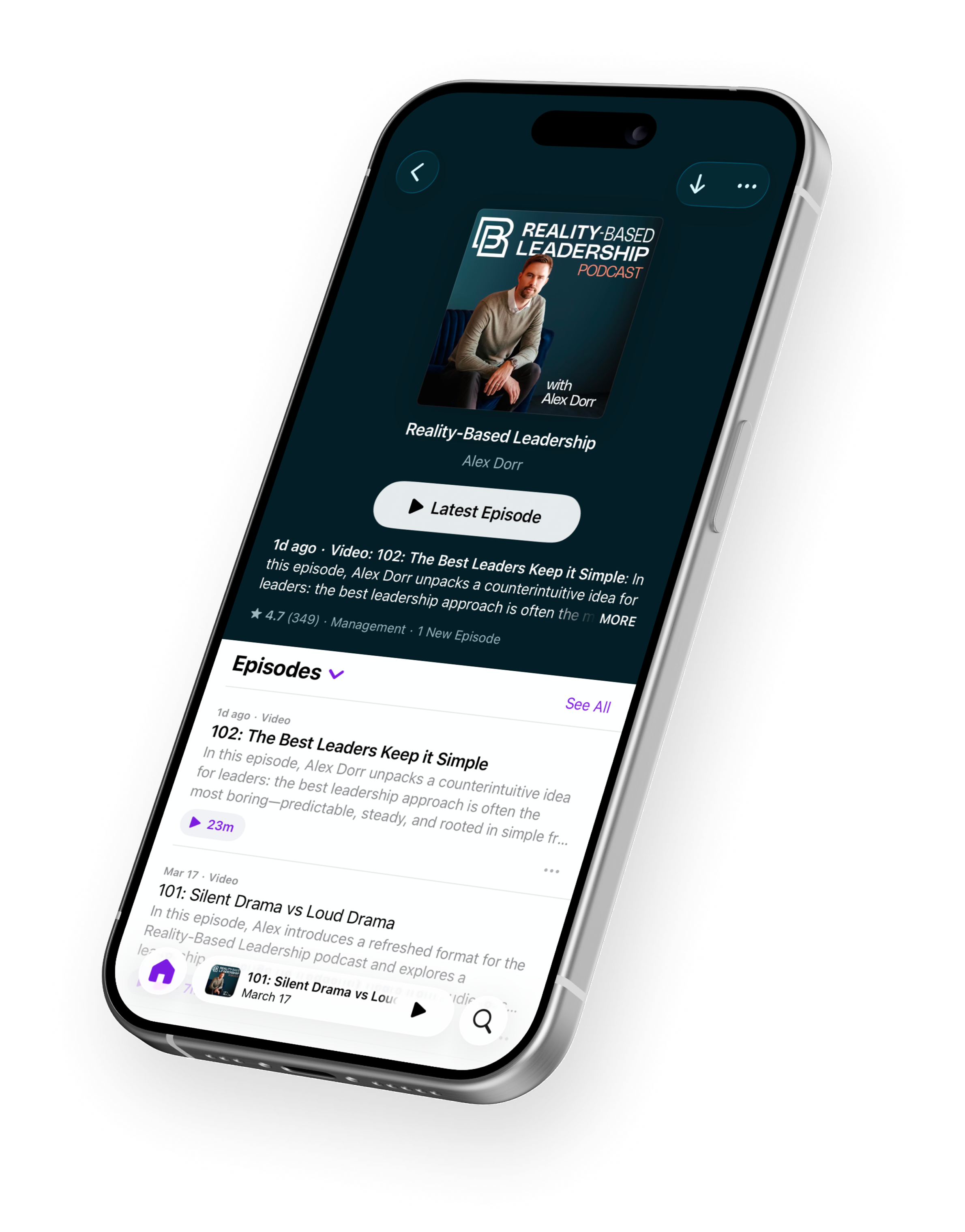
Episodes



109: Why Accountability Drives Results
In this episode, Alex Dorr simplifies one of the most misunderstood concepts in leadership: personal accountability. Far from being a buzzword or a blame tool, Alex reframes accountability as a mindset that directly drives happiness, engagement, and results.
He breaks down why accountability has been watered down in leadership conversations—and why that’s a problem. Drawing on research and real-world leadership patterns, Alex introduces a powerful framework built on four key elements: commitment, resilience, ownership, and continuous learning. Together, these form the foundation of high-performing, highly engaged teams. The episode ultimately challenges leaders to stop avoiding accountability conversations and instead coach it intentionally, using simple but powerful questions that shift teams out of excuses and into ownership and action.
Episode Highlights:
00:00:00 — Why accountability has become overcomplicated—and why it’s not a dirty word.
00:01:30 — The problem: accountability as a buzzword that leaders ignore or misunderstand.
00:03:00 — The truth: accountability is a mindset, not a skill set.
00:05:30 — Internal vs. external locus of control and how it shapes performance.
00:07:30 — The 50-10-40 model: where happiness and results actually come from.
00:10:30 — Why accountability drives both engagement and performance.
00:13:00 — The four factors of accountability: commitment, resilience, ownership, and learning.
00:17:30 — The danger of “conditional buy-in” and how it leads to excuses.
00:21:00 — Coaching accountability: asking “Are you all in?” and getting real commitment.
00:24:30 — Practical questions leaders can use to build accountability on their teams.
108: Suffering at Work is Optional
In this episode, Alex Dorr tackles a foundational mindset shift that can radically change how leaders experience work: suffering is optional—and often self-imposed. Through relatable stories and practical frameworks, Alex unpacks how most workplace stress doesn’t come from reality itself, but from the stories we attach to it.
He introduces three common patterns—pre-suffering, post-suffering, and group suffering—that quietly drain energy and derail teams. From “Sunday scaries” to reliving past frustrations, these habits keep leaders stuck in cycles of unnecessary stress. Alex challenges listeners to separate facts from the narrative their minds create, using simple tools like asking, “What do I know for sure?” to interrupt reactive thinking. The result? Clearer decisions, better energy management, and more engaged teams.
Episode Highlights:
00:00:00 — The core idea: you can choose to experience work with joy or misery.
00:01:30 — Why suffering at work is often self-imposed, not caused by reality.
00:03:00 — Pre-suffering: stressing about future events before they even happen.
00:04:30 — Post-suffering: reliving past problems that are already resolved.
00:05:45 — Group suffering: how teams normalize negativity and shared frustration.
00:07:00 — The real source of stress: the story you tell yourself—not the situation itself.
00:08:30 — The “tape vs. rat” story: how quickly we escalate harmless situations into crises.
00:10:30 — A practical tool: separating facts from assumptions to reduce emotional reactivity.
00:12:00 — How teams turn simple changes into worst-case scenarios.
00:14:00 — Why energy management—not circumstances—is the real competitive advantage.
107: Stop Judging, Start Helping
In this episode, Alex Dorr zeroes in on one of the most powerful and transformative principles in leadership: “stop judging, start helping.” If there were only one mindset shift to improve culture, collaboration, and results, this would be it.
Drawing from real-world leadership moments, Alex explains how quickly teams fall into judgment—blaming others, telling negative stories, and disengaging from solutions. But the moment leaders interrupt that pattern and redirect toward helpful action, everything changes. From workplace dynamics to personal relationships to innovation, this simple principle unlocks clarity, accountability, and forward momentum. Ultimately, this episode challenges leaders to make “stop judging, start helping” a daily, non-negotiable habit that reshapes how teams think, communicate, and perform.
Episode Highlights:
00:00:00 — The one principle that can transform your team: stop judging, start helping.
00:01:00 — Why leaders default to thinking “someone else needs this” instead of applying it themselves.
00:03:00 — The core truth: the moment you start judging is the moment you stop leading.
00:05:00 — Brain science: why you can’t judge and help at the same time.
00:07:30 — How judgment spreads through teams and shapes culture (“where the leader goes, so goes the team”).
00:10:00 — Coaching in real time: shifting a high performer from judgment to helpful action.
00:12:30 — Breaking silos and conflict by replacing blame with collaboration.
00:15:30 — How removing judgment unlocks creativity and innovation in teams.
00:18:30 — Setting boundaries in life: using “start helping” to redirect negative conversations.
00:20:30 — The practical takeaway: make “stop judging, start helping” a team-wide habit.
106: How to AI-Enhance Your Drama Ditching at Work
In this episode, Alex Dorr explores a forward-thinking leadership topic: how to use AI to enhance decision-making, reduce workplace drama, and unlock better solutions. Drawing from a recent live event, Alex walks through how modern leaders can combine Reality Based Leadership tools with AI to break through stuck thinking and accelerate progress.
Rather than replacing human insight, AI becomes a powerful thought partner—helping teams generate ideas when energy is low, accountability is avoided, or creativity stalls. Alex highlights how tools like “thinking inside the box” and SBAR can be supercharged with AI to move teams from “why we can’t” into “how we could.” The episode ultimately reframes AI as a leadership advantage: not just for efficiency, but for expanding thinking, increasing accountability, and driving next right action.
Episode Highlights:
00:00:00 — Introducing the idea: using AI to enhance leadership and ditch workplace drama.
00:01:30 — Why modern leaders are shifting from managing work to managing energy and thinking.
00:03:30 — The opportunity: combining AI with Reality Based Leadership tools.
00:06:00 — How the “thinking inside the box” framework helps teams move from excuses to solutions.
00:08:30 — When teams get stuck: the role of ego, avoidance, and lack of willingness.
00:10:30 — Using AI as a creative partner to generate breakthrough ideas within constraints.
00:12:30 — The key insight: AI never runs out of ideas—even when teams do.
00:13:45 — Identifying the real blockers: skill gaps, outdated approaches, or lack of willingness.
00:14:45 — Enhancing the SBAR framework with AI to improve analysis and recommendations.
00:15:45 — Why AI should support (not replace) human thinking and collaboration.
105: Why High Performers are Hard to Lead (and How Great Leaders Handle It)
In this episode, Alex Dorr explores a nuanced leadership question: why can high performers be difficult to lead? Drawing from conversations sparked by viral social content and years of Reality Based Leadership work, Alex distinguishes between high performance and high accountability—two traits that often overlap, but are not always the same.
He explains how strong performers can become challenging when they slip into righteousness, start judging others, or resist the responsibility to help elevate the team around them. Alex also unpacks how shifting workplace realities, evolving standards, and rapid change can expose whether someone is truly adaptable—or simply relying on past success. The episode ultimately challenges leaders to create cultures that support excellence without enabling drama, and to ensure their highest performers remain grounded in accountability, not just output.
Episode Highlights with Timestamps:
00:00:00 — Introducing the question: why are high performers often difficult to lead?
00:02:24 — The important distinction between high performance and high accountability.
00:04:21 — Why the same workplace cannot satisfy both high-accountability and low-accountability mindsets.
00:05:45 — How some high performers become difficult when they step out of accountability.
00:07:10 — The danger of “judging the judges” and when top performers start creating drama.
00:10:00 — Why performance is increasingly becoming pass/fail in a changing, AI-shaped workplace.
00:12:15 — How yesterday’s top performer can become average if they are not ready for what’s next.
00:13:10 — High-accountability people get nervous when change is not happening.
00:14:30 — Why great performers want leaders to hold the standard, not lower it.
00:15:45 — Helping high performers lead with mentorship instead of judgment.
Follow Alex on social media: @alexmdorr
104: Feeling Disengaged at Work?
In this episode, Alex Dorr tackles a challenge that impacts nearly every workplace: disengagement. Prompted by sobering data that nearly 70% of employees feel disengaged at work, Alex unpacks why this happens—and more importantly, how to break the cycle. He reframes engagement as a personal choice, not just an organizational outcome, and challenges listeners to stop waiting for perfect conditions before leaning in.
Through practical frameworks and real-world examples, Alex explains how stress, change, and “unpreferred reality” tempt people to mentally check out. Instead of falling into complaint or avoidance, he introduces a more empowering path: finding the “space for impact”—the narrow but powerful place between current reality and what great could look like. The episode is packed with actionable tools to help individuals and teams re-engage, take ownership, and rediscover purpose in their work. Ultimately, this conversation is both a wake-up call and a roadmap: engagement isn’t about circumstances—it’s about how you choose to show up within them.
Episode Highlights with Timestamps:
00:00:00 — Why this episode matters: addressing widespread disengagement at work.
00:02:00 — The reality of disengagement: Gallup data and the cost of employees mentally checking out.
00:05:30 — Engagement is a choice—even in difficult or imperfect environments.
00:08:45 — Where disengagement begins: stress, change, and “unpreferred reality.”
00:10:30 — The trap of arguing with reality vs. taking responsibility for impact.
00:12:00 — Finding the “space for impact” between current reality and what great looks like.
00:14:30 — The “given that” framework: shifting from excuses to action.
00:18:30 — Editing your story: separating facts from assumptions to unlock clarity.
00:22:00 — Practical tools for teams: inside-the-box thinking and crowd-sourcing solutions.
00:25:00 — Shared accountability: what leaders and teams must both own to create engagement.
103: How Drama Multiplies
In this episode, Alex Dorr explores a powerful and often overlooked leadership question: does drama have an even bigger impact than we think? Building on Reality-Based Leadership’s well-known 3X drama multiplier, Alex breaks down how drama doesn’t just affect individual performance—it compounds across teams, cultures, and especially leadership levels.
He introduces a simple but revealing equation for understanding the total value someone brings to a team: current performance + future potential – drama quotient. Through real-world examples, Alex highlights the danger of the “toxic high performer” and why technical skill alone isn’t enough to define value. The conversation takes a deeper turn as he challenges leaders to consider how their own behavior—especially at higher levels—can amplify drama far beyond a 3X effect. Ultimately, this episode is a call to greater awareness: how leaders show up, respond, and communicate has a ripple effect that shapes the entire organization.
For more information on the SBAR tool, check out Alex's YouTube video:https://youtu.be/wLBUIVTzVIE
Episode Highlights with Timestamps
00:00:00 — Introducing the question: does drama have a bigger impact than the 3X multiplier suggests?
00:01:45 — The reality of workplace drama increasing to 2.5 hours per day per employee.
00:03:10 — The disconnect between high performance ratings and actual team results.
00:06:40 — The “toxic high performer” problem: high skill, high drama, low overall value.
00:07:50 — Breaking down the value equation: performance + potential – drama quotient.
00:10:30 — Why drama carries a 3X negative multiplier in team environments.
00:14:50 — Comparing two high performers: skill alone vs. attitude and adaptability.
00:18:30 — Why a “zero” (balanced performance and low drama) is the ideal sustainable target.
00:20:40 — How leadership amplifies drama—why higher roles may carry an even greater multiplier.
00:22:50 — Simple leadership responses (“Wow, good to know”) that create space and reduce reactive drama.
102: The Best Leaders Keep it Simple
In this episode, Alex Dorr unpacks a counterintuitive idea for leaders: the best leadership approach is often the most boring—predictable, steady, and rooted in simple frameworks. Drawing from a recent insight after a speaking engagement, Alex challenges the tendency to overcomplicate leadership with clever tactics instead of relying on consistent, proven approaches.
He explains how great leaders anchor themselves in repeatable frameworks rather than reacting on instinct, allowing them to stay grounded when teams bring problems, stress, or drama. Through practical tools like “stop judging, start helping,” The Call to Greatness framework, and the “given that” mindset, Alex shows how leaders can guide conversations toward accountability and next right action. The episode ultimately reframes leadership as less about being impressive and more about being dependable—creating the structure teams need to thrive, grow, and solve problems on their own.
Episode Highlights with Timestamps
00:00:00 — Why the most effective leadership approach is simple, steady, and “boring.”
00:01:10 — The problem with overcomplicating leadership instead of recognizing repeatable patterns.
00:02:10 — Great leaders rely on consistent frameworks—not gut reactions—to handle challenges.
00:03:20 — Meeting stressed team members with neutrality and creating a safe place to land.
00:04:35 — “Stop judging, start helping” as a foundational leadership mantra.
00:06:00 — Shifting conversations from blame to “what’s the most helpful next step?”
00:08:30 — The Call to Greatness framework: love people up, then call them up to accountability.
00:12:00 — Using accountability questions like “What’s your part in this?” to drive growth.
00:15:30 — The “given that” mindset: accepting reality and focusing on what great looks like next.
00:18:45 — Why predictable leadership builds trust and empowers teams to solve problems independently.
101: Silent Drama vs Loud Drama
In this episode, Alex introduces a refreshed format for the Reality-Based Leadership podcast and explores a leadership challenge he frequently hears from audiences: the difference between loud drama and silent drama in the workplace. Alex explains how drama—defined as thought patterns or behaviors that pull people away from results and happiness—can quietly consume hours of productivity each day.
He breaks down the visible forms of drama like venting, gossiping, and judgment, while also uncovering the more subtle patterns that derail teams beneath the surface—such as choosing preference over potential or misunderstanding decision-making roles. Alex also shares practical tools leaders can use to interrupt drama, including editing the stories we tell ourselves and using structured frameworks to turn complaints into solutions. The episode challenges leaders to recognize where drama may be hiding in their teams and how intentional leadership can redirect that energy toward accountability and results.
Episode Highlights with Timestamps
00:00:00 — Introducing the podcast’s new format and the mission to help leaders ditch workplace drama.
00:01:41 — Defining drama as behaviors or thinking that pull teams away from results and engagement.
00:03:34 — Recognizing loud drama: gossip, venting, scorekeeping, and ego-driven reactions.
00:05:16 — Why the common “Do you have a minute?” conversation often leads to workplace drama.
00:07:07 — The difference between sharing feelings and venting that fuels negative stories.
00:09:20 — Using the “Edit Your Story” approach to separate facts from assumptions.
00:12:16 — Turning problems into solutions using the SBAR framework.
00:14:32 — What silent drama looks like when resistance hides beneath the surface.
00:15:41 — Choosing preference over potential and how it quietly undermines teams.
00:17:01 — Understanding the roles of decision maker, consultant, and informed contributor.
Negativity At Work And How To Address It (Question from a fan)
In this week's episode, Cy and Alex were able to take a fan question that was submitted through the website. The question focused on what to do about negativity at work, and in particular this was part of a group that was going through a residency program.
And so in this episode, Cy and Alex take a look at the question and go into some of their favorite techniques to reflect on the situation that has become negative.
What are some ways that you could reset the negativity and maybe come out at a different angle? What are some tried and true techniques to be able to influence the negativity and hopefully turn it into a better spirit and a better environment of how we could make things better?
Lots of good information and techniques in this episode, so if you've ever been on a team or situation where negativity becomes the norm or people get into patterns of negativity, and you're not sure how to stop it or shift that energy, you'll really love this discussion and find some good takeaways from there.
Be sure to share this episode with all of your team members and discuss your biggest insight or takeaways.
Careful To Not Weaponize Reality-Based Leadership With Your Team
This week's episode is all about a common pattern that happens when people are really excited about Reality-Based Leadership, or they just learned some of our new techniques after a session.
They accidentally begin weaponizing Reality-Based Leadership, and the ideas. We get it, you're excited about some new approaches and really looking forward to trying to shift a place your team has been stuck, or an individual has been stuck for a long time. What often happens, is people grab the harshest part of the message and use it on the person that's running away from them the fastest, and then the content doesn't work.
This is one example of many that are talked about in this week's podcast of where the loving part of Reality-Based Leadership gets weaponized and used for evil. So today's episode, Cy and Alex discuss some of the ways that great techniques that can work most of the time, get used in a way that's harsh and actually backfires for people that are excited about Reality-Based Leadership.
This can affect even the most seasoned practitioners of our content and tools, so this is a great reminder. In fact every two years just like what sparked this episode, there's usually an example that comes through that someone grabbed a deeper part of the philosophy and used that first in their very next meeting after a session, and we hear reports that it backfired, then the groups a little bit turned off from RBL.
This podcast is designed to help those who may have experienced setbacks, offering a chance to reset, as well as those eager to maintain the momentum they've built with their teams. It's all about preventing the misuse of the tools, practices, and techniques of Reality-Based Leadership, while ensuring we focus on loving people up so we can call people up to greatness.
Data we HAD to share - Our Leadership Development Learning Series and Process
In this episode, Cy and Alex share some incredible insights from Reality-Based Leadership's Leadership Development Series! While many know them for their engaging keynotes, their deep dive programs are all about transforming teams into modern leaders who can ditch the drama and turn excuses into tangible results.
They reveal some impressive data from participants, showcasing significant boosts in career satisfaction and leadership skills. For instance, 50% of respondents reported higher job satisfaction, 94% said they’d stay in their roles post-course, and burnout was reduced by an astounding 50%!
On the leadership side, 55% feel more confident coaching others on the spot, while 70% have enhanced their ability to hold teams accountable. Plus, 60% are ready to lead their teams through change with newfound confidence. Remarkably, 80% are excited to drive results without just hoping for the best. And every single participant is now using at least one powerful tool daily to elevate their leadership.
Cy and Alex also explain how the program is structured, from interactive sessions to group coaching and ongoing support that truly makes a difference. If your current training isn't delivering the results you’re looking for, this conversation is a must-listen. And if you’re interested in redesigning your curriculum, Ana from our team can work with you to create a tailored approach for your team. Don’t miss out! Email us today at info@realitybasedleadership.com
Silence -The Most Underused Tool For Great Leadership
A leader recently asked Alex and Cy, “What happens when you're trying Reality-Based Leadership or using a tool and everything goes silent? Does that mean that the tools not working? What do I do when there's silence? What do I do when that silence feels like it has some extra tension attached to it, is it working?”
All of these questions came up and in this podcast, Cy and Alex explore their own experiences in coaching with running their own business facilitating tools that have led to silence. And what that really means from a Reality-Based Leadership perspective.
Many people believe that something is not working when there's silence after introducing a tool technique, coaching question, but we would say that actually means you are just beginning Reality-Based Leadership and getting to the good stuff, cultivating accountability. Self reflection is the foundation of accountability, and self reflection often includes silence.
So in this episode, we're going to share with you ways to use silence to better your leadership and prove your use of the tools and most importantly, moving people from why we can't to how we could. And moving people from where they're stuck into where they're hoping to be.
You'll love this episode. We had fun doing it and can't wait to hear your feedback on ways you can use these tools in your leadership.
Handling Fake Buy-In From Employees
One of the top three biggest questions we get at Reality-Based Leadership is, How do I get my team to buy-in? How do I get them to buy into what needs to be done? How do I get them to buy into strategies? How do we get people to buy into changes the organization needs us to execute on?
And the next question after that is, what do I do If I thought I had buy-in, and then it turned out it was fake, or it seems to be where people say they're bought in, but the behaviors are different?
So in this podcast, Cy and Alex talk about this pattern, if it's happening and how you might be able to address fake buy in, how you can go after more buy in, and the truth is, buy in is the first step of accountability.
It's about commitment. Buy in is a verb and if an individual isn't able to offer up their buy-in, it's really game over when it comes to happiness results in engagement at work.
So Cy and Alex do all they can to come up with our best techniques to help you go after buy-in, secure buy-in, but remember you can only work with the willing, you can't buy someone else in, and this podcast will give you some techniques to figure out what's really going on.
Creating Structure to Give Freedom to Employees
Many leaders struggle with giving freedom for their employees to do their best work, because they forget to provide some structure for them to work in.
In today's episode, Alex and Cy talk about leader's role in finding the balance between structure and play. In the conversation, they go into a key Reality-Based Leadership focus that all leaders need to have, is setting your nonnegotiable as a leader to then get people to buy into those. From there, people are allowed to bring their best self play in the workplace so to speak and create magic.
They also cover why it's so important to focus on this balance because too much structure and people believe we're over proceduralized. And they feel like they can't do any work and too much play, then it's really a free-for-all and innovation can't happen.
So the magic comes from just enough structure and then people are allowed to innovate and collaborate knowing they have the same basics, so this is a really, really important episode to setting the groundwork for good leadership and Cy and Alex can't wait to hear your thoughts.

Hire RBL for your next event!